

The urban digital twin has matured, in roughly twenty years, from a high-resolution rendering exercise into a distributed, event-driven, AI-augmented control system that increasingly sits on the critical path of municipal operations. For technologists working in this space — whether at hyperscalers building twin platforms, system integrators delivering city programmes, or engineering firms instrumenting infrastructure — the trajectory is not academic. It defines the reference architectures we ship, the standards we bet on and the engineering problems we are paid to solve.
This article traces that trajectory through five distinct generations of capability, each defined by the question its architecture could finally answer, the technical constraints that bounded it, and the unsolved problems that drove the next leap.
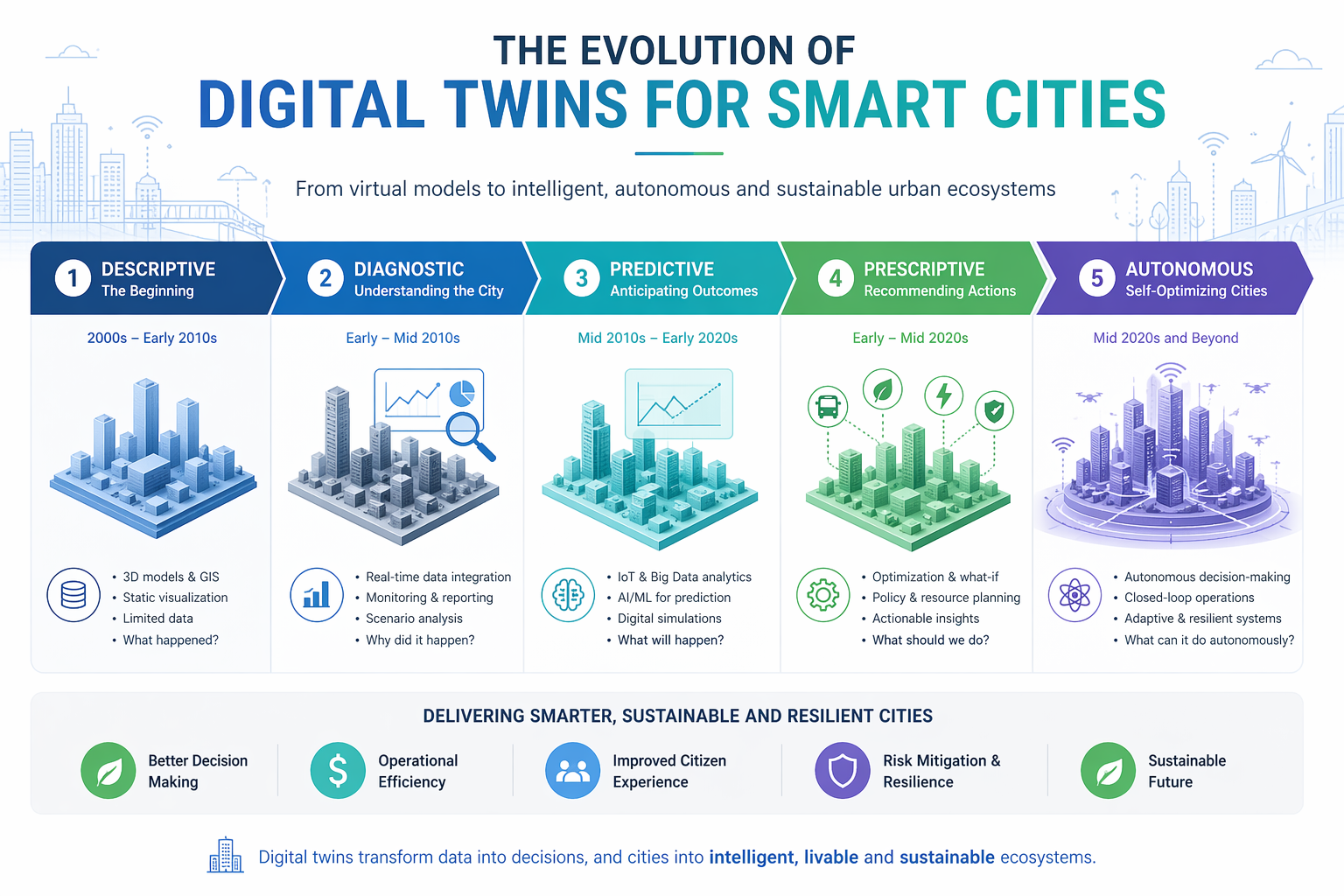
Era One: The Descriptive Twin — What Happened?
Timeframe: 2000s through early 2010s Defining question: What is the city, geometrically and semantically?
The first generation of urban digital twins was, in architectural terms, a presentation layer sitting atop a geospatial database. The stack was bounded: ESRI’s geodatabase or PostGIS at the data tier; CityGML or proprietary BIM formats for built-environment semantics; 3D rendering engines (often game-engine-derived) for visualisation; and a thin scripting layer for queries.
The defining technical achievement of this era was semantic geometry — moving beyond pixels to objects with attributes. A building was no longer a textured polygon; it was an entity with floors, materials, ownership, function and connectivity. CityGML’s Levels of Detail (LoD 1–4) formalised this, and the OGC’s standardisation work gave the industry a common vocabulary.
The constraints were severe. Data was overwhelmingly batch-loaded from surveys, cadastral records and BIM exports. There was no real-time pipeline. Compute was monolithic. Storage was relational and ill-suited to graph-structured urban data. And the rendering tier was decoupled from any operational system — the twin was, in effect, a visualisation veneer over a static dataset.
Singapore’s Virtual Singapore programme, built on Dassault Systèmes’ 3DEXPERIENCE platform, is the canonical reference. It demonstrated that a city could be modelled at a metre’s fidelity across an entire territory. It also exposed the limitation that would define the next decade of work: a twin that does not breathe with its physical original is, at best, a high-fidelity archive.
Era Two: The Diagnostic Twin — Why Did It Happen?
Timeframe: Early to mid-2010s Defining question: What is the city doing, right now, and why?
The diagnostic era was the moment urban twins absorbed the architectural patterns of industrial SCADA and modern observability. Three enabling shifts converged: the collapse in IoT hardware cost (LoRaWAN, NB-IoT, and edge-capable microcontrollers under five dollars), the maturation of message-streaming infrastructure (Kafka, MQTT brokers, AMQP), and the rise of time-series databases purpose-built for sensor telemetry (InfluxDB, TimescaleDB, later Prometheus for operational metrics).
The reference architecture became layered and recognisable to any senior platform engineer: an ingestion tier (MQTT or HTTP, with edge gateways aggregating low-power devices), a streaming bus (Kafka or its managed equivalents), a hot path for real-time dashboards and a cold path into a data lake (initially Hadoop, increasingly object storage with Parquet) for historical analysis. The twin itself became the materialised view sitting atop these flows — a continuously updated representation, not a periodically refreshed one.
This is the era in which urban operations centres were rebuilt around the twin. Dubai’s Smart City command structure, Helsinki’s Kalasatama district, Amsterdam’s circular-economy dashboards, Barcelona’s Sentilo platform — all are products of this generation. The operational pattern was single-pane-of-glass monitoring with drill-down to root cause: a congestion event traced back to a specific signal misconfiguration, an energy spike correlated with HVAC behaviour in a specific district, a water-pressure anomaly localised to a particular DMA.
What the diagnostic twin could not yet do was reason forward in time. Correlation queries were easy; causal models were not. And as sensor counts climbed into the hundreds of thousands per city, the limits of human cognition — even augmented by good dashboards — became the binding constraint. The data was there; the inference was not.
Era Three: The Predictive Twin — What Will Happen?
Timeframe: Mid-2010s through early 2020s Defining question: Given current state and history, what is the system most likely to do next?
The predictive era is, in retrospect, where the field acquired its modern technical identity. It was driven by the same forces that reshaped every data-intensive industry in the same window: cheap GPU compute, the convergence on deep learning frameworks (TensorFlow, PyTorch), the maturation of MLOps tooling (MLflow, Kubeflow, model registries), and the arrival of cloud-native ML services from the hyperscalers.
For urban twins, the technical innovations were substantive. Spatio-temporal forecasting moved beyond classical ARIMA and Kalman approaches toward graph neural networks, which proved exceptionally well-suited to networked urban systems — road graphs, water distribution networks, power grids and transit topologies all have natural GNN formulations. Traffic prediction in particular advanced rapidly with architectures like ST-GCN and its successors. Computer-vision pipelines, increasingly running on edge inference hardware (NVIDIA Jetson, Coral, later domain-specific accelerators), brought real-time scene understanding into the twin: vehicle counts, pedestrian flows, crowd density, parking occupancy.
The architectural picture became substantially more complex. The data lake bifurcated into a data lakehouse pattern (Delta Lake, Iceberg, Hudi) to reconcile streaming and batch. Feature stores emerged to maintain consistency between training and serving. Simulation engines — agent-based for mobility, CFD for air and water, FEM for structural — were coupled to the live twin, fed by its data and producing synthetic futures. The Functional Mock-up Interface (FMI/FMU) standard gained traction as the glue between heterogeneous simulators, allowing transport, energy and emissions models to be co-simulated against a shared scenario.
Standards work matured in parallel. Microsoft’s Digital Twin Definition Language (DTDL) and the broader Industry Foundation Classes (IFC) ecosystem provided semantic models. ONNX became a viable interchange format for ML models across runtimes. ISO 23247 codified digital-twin frameworks for manufacturing — and was rapidly borrowed into urban contexts.
Predictive twins began to deliver economically meaningful outcomes: predictive maintenance shifting failure-mode interventions weeks ahead of incidents; demand-response forecasting reducing peak-load infrastructure investment; traffic prediction enabling adaptive signal control with double-digit travel-time improvements. The technology had crossed the line from promising to operational.
What it still lacked was prescriptive intelligence. Knowing what will happen is not the same as knowing what to do about it.
Era Four: The Prescriptive Twin — What Should We Do?
Timeframe: Early to mid-2020s Defining question: Across the space of feasible interventions, which one optimises our objectives?
The prescriptive era reframes the twin as an optimisation surface. Where the predictive twin produces forecasts, the prescriptive twin produces recommendations, generated by coupling the predictive layer with an optimisation or decision-policy layer.
Technically, this manifests in several patterns:
Scenario simulation at scale. Cloud elasticity makes it feasible to run thousands of parallel what-if simulations against the live twin state — exploring intervention spaces (signal-timing changes, bus rerouting, dynamic tolling) and ranking outcomes against multi-objective utility functions. Modern simulation pipelines orchestrate this with Kubernetes-native job schedulers and headless instances of agent-based simulators like SUMO or MATSim.
Mathematical optimisation embedded in the twin. Linear, integer and constraint programming (Gurobi, CPLEX, OR-Tools) are routinely invoked for problems with clean structure — crew dispatch, vehicle routing, asset replacement scheduling, energy unit commitment. The twin provides the live state; the solver returns an action plan; the plan is dispatched to operations.
Reinforcement learning for sequential decision problems. For domains where classical optimisation breaks down — adaptive traffic signal control, building energy management, district heating balancing — deep RL agents trained against high-fidelity simulators are emerging from research into production. The pattern is consistent: train in simulation, validate in shadow mode against live data, deploy with human oversight, retrain as drift accumulates.
Causal inference, not just correlation. Prescription requires causal structure: knowing that intervening on X will change Y, not merely that X and Y co-vary. Tools like DoWhy, EconML and the broader Pearl-school causal toolkit have moved from academia into production analytics, particularly for policy evaluation and equity analysis.
The architectural shift this era demands is significant. The twin is no longer read-mostly; it is read-and-recommend. Governance, auditability and explainability become first-class system requirements. Every recommendation must carry a traceable lineage — which model produced it, against which data snapshot, using which assumptions, with what confidence interval. This is where MLOps maturity, model registries, feature store lineage and decision-logging pipelines stop being best practice and start being legal necessity.
Major platform vendors have positioned themselves around this generation. Azure Digital Twins, AWS IoT TwinMaker, NVIDIA Omniverse (with its Cesium-based geospatial extensions), Bentley iTwin and Siemens Xcelerator each offer different angles on the same architectural challenge: how to compose a recommend-capable twin from heterogeneous data sources and modelling primitives.
Era Five: The Autonomous Twin — What Can the City Operate by Itself?
Timeframe: Mid-2020s onward Defining question: Within what operational envelope can the twin act, learn and adapt without per-decision human intervention?
The autonomous era closes the loop. The twin transitions from a recommender system to a controller — within carefully bounded domains, the recommendation becomes an actuation command, and the consequence feeds back into the next reasoning cycle.
The technical pattern is the closed-loop control architecture, scaled up from the plant floor to the city scale. The components are familiar in isolation:
- Edge inference for low-latency decisions that cannot tolerate cloud round-trips (signal control, video analytics, local protection logic).
- Cloud-tier orchestration for cross-domain optimisation, fleet-wide model training and long-horizon planning.
- Digital thread integration so that decisions, sensor states, model versions and physical outcomes are linked in an auditable chain — the urban analogue of the digital thread concept long established in aerospace and defence.
- Foundation models as reasoning layers — increasingly, large language and multi-modal models are being integrated as natural-language interfaces to the twin and, more interestingly, as planning and tool-use agents capable of orchestrating actions across multiple subsystems. The pattern here is agentic: the LLM decomposes a goal, calls the predictive and prescriptive subsystems as tools, and assembles an action plan that human operators approve or supervise.
- Federated and privacy-preserving learning so that models can be trained across jurisdictions, operators and vendors without centralising sensitive data — a hard requirement for cross-utility coordination and for citizen-data use cases.
The hardest engineering problems of this generation are not the components — they are the integration properties of the assembled system: stability under adversarial conditions, graceful degradation when components fail, bounded action spaces that prevent runaway behaviours, and observable, explainable decision traces that satisfy regulatory and democratic accountability requirements.
The autonomous twin is, today, partly real and partly aspirational. Closed-loop control is mature in narrow domains — district energy systems, advanced traffic management on signalised corridors, water network pressure optimisation, smart-building HVAC. It is not yet mature across the urban whole. The next decade is, in essence, the work of widening these envelopes safely.
The Hard Problems Now Defining the Field
Stepping back from the generational arc, the technical agenda for the coming years is reasonably clear. Five problems dominate.
Semantic interoperability at scale. The single biggest impediment to twin value is heterogeneity of representation. Transport, energy, water, buildings and emergency services each have mature data models, none of which align. DTDL, CityGML, IFC, BRICK, SAREF, IEC CIM and OGC SensorThings each cover a slice. The work of harmonisation — ontology mediation, schema mapping, increasingly LLM-assisted semantic translation — is unglamorous but determinative.
Temporal and spatial fidelity trade-offs. A twin updated every second across an entire city at metre fidelity is technically possible and economically untenable. Architectures must reason about which entities require which update frequencies, which can be approximated, and how to migrate fidelity dynamically as situations escalate. This is essentially a CQRS-and-eventual-consistency problem at urban scale, and it is unsolved in general form.
Model drift and continual learning. Cities change. Models trained on pre-pandemic mobility patterns failed catastrophically in 2020 and again in the post-pandemic re-normalisation. Production twins require monitoring for distributional drift, automated retraining triggers, shadow-deployment patterns and rollback procedures — the full MLOps lifecycle, adapted for systems where the cost of a bad model in production is measured in lives, not click-through rates.
Sovereignty, privacy and the regulatory perimeter. GDPR, sectoral data regulations, and emerging AI acts (notably the EU AI Act) place real constraints on what urban twins can ingest, infer and act upon. Architectures must be designed with data residency, purpose limitation, automated decision-making transparency and citizen-rights interfaces as first-order requirements, not retrofits.
Open standards versus platform lock-in. Every hyperscaler and major engineering vendor is competing to be the canonical twin platform. Cities — which operate on multi-decade procurement horizons — cannot afford to bet on a single vendor’s roadmap. The successful programmes of the next decade will be those built on open standards (DTDL, OGC, FMI, ONNX), open simulators (SUMO, OpenFOAM, EnergyPlus) and portable runtimes (Kubernetes, OCI containers), with vendor capabilities consumed as interchangeable services rather than as the foundation itself.
What This Means for the Builders
For technologists working in this space, the implications are practical.
The reference architecture is converging. The five-layer pattern — physical ingestion, time-series and graph storage, semantic twin layer, simulation and ML services, application and interaction layer — has stabilised enough that greenfield programmes should adopt it by default and deviate only with reason.
The differentiation is moving up the stack. The data, ingestion and storage tiers are commodity. The semantic models, the domain-specific simulators, the trained policies and the agentic orchestration layers are where defensible value is being created.
The talent profile is changing. The twin team of 2015 was geospatial engineers and visualisation specialists. The team of 2026 is platform engineers, ML practitioners, simulation specialists, controls engineers and increasingly, AI safety and governance specialists. Hiring and team design need to reflect this.
And the procurement model is shifting. Cities are moving away from monolithic vendor contracts toward composable platform programmes — opinionated reference architectures, open standards, multiple vendors integrated through well-defined interfaces. Vendors that adapt to this model will win. Those that hold the line on proprietary lock-in will increasingly be confined to greenfield programmes in less mature markets.
The Twin That Knows the City
The arc from descriptive map to autonomous controller is, technically, a story of progressive coupling between the digital and physical systems. We began with a snapshot of geometry. We added a heartbeat of telemetry. We taught the system to forecast. We taught it to recommend. We are now teaching it to act.
What has not yet been fully built — and is the real prize of the next decade — is the twin that understands the city in context. One that integrates not just sensors and simulators but social, economic and political signals; one whose recommendations are not merely optimal but legitimate; one whose autonomy is bounded by transparent contracts with the citizens whose lives it shapes.
That twin will not be built by any single vendor, in any single platform, on any single cloud. It will be built by the technologists who internalise that the digital twin is, ultimately, a sociotechnical system — and that the engineering discipline required to deliver it well now extends well beyond traditional software boundaries into governance, ethics and democratic accountability.
The cities that get this right will not merely be efficient. They will be self-aware, in the deepest sense the term can carry for a complex adaptive system. The work of getting them there is the work in front of us.
References & Further Reading
Standards and Specifications
- OGC CityGML 3.0 Conceptual Model — Open Geospatial Consortium standard for semantic 3D city models. https://www.ogc.org/publications/standard/citygml/ · Full specification: https://docs.ogc.org/is/20-010/20-010.html
- Digital Twins Definition Language (DTDL) v3 — Microsoft / Azure open specification, JSON-LD based. GitHub: https://github.com/Azure/opendigitaltwins-dtdl · Specification: https://azure.github.io/opendigitaltwins-dtdl/DTDL/v3/DTDL.v3.html
- Industry Foundation Classes (IFC) — buildingSMART International, open BIM data model. https://www.buildingsmart.org/standards/bsi-standards/industry-foundation-classes/
- Functional Mock-up Interface (FMI) — Modelica Association open standard for model exchange and co-simulation, currently FMI 3.0. https://fmi-standard.org/
- ISO 23247 — Digital Twin Framework for Manufacturing — Reference framework increasingly adopted in urban and infrastructure contexts. https://www.iso.org/standard/75066.html
- Brick Schema — Open-source ontology for smart-building metadata. https://brickschema.org/
- SAREF (Smart Applications REFerence ontology) — ETSI ontology for IoT and smart appliances. https://saref.etsi.org/
- OGC SensorThings API — Open standard for IoT sensor interconnection over the web. https://www.ogc.org/publications/standard/sensorthings/
- IEC Common Information Model (CIM) — Power-system data exchange standards (IEC 61968 / 61970 / 62325). https://www.iec.ch/smartgrid/standards
- ONNX (Open Neural Network Exchange) — Open format for interchange of ML models across runtimes. https://onnx.ai/
Major Platforms
- Microsoft Azure Digital Twins — PaaS for twin graphs based on DTDL. https://learn.microsoft.com/en-us/azure/digital-twins/
- AWS IoT TwinMaker — Managed digital twin service with native integration to AWS IoT SiteWise and S3. https://aws.amazon.com/iot-twinmaker/
- NVIDIA Omniverse — OpenUSD-based platform for physics-accurate simulation and visualisation, increasingly used as a 3D twin substrate. https://www.nvidia.com/en-us/omniverse/
- Bentley iTwin Platform — Cloud platform for infrastructure digital twins, with Omniverse and Cesium integrations. https://www.bentley.com/software/itwin/
- Siemens Xcelerator — Open business platform spanning IoT, MindSphere lineage, and digital-twin engineering tooling. https://www.siemens.com/global/en/products/services/digital-enterprise/xcelerator.html
- Dassault Systèmes 3DEXPERIENCity — The platform underpinning Virtual Singapore. https://www.3ds.com/insights/customer-stories/virtual-singapore
- Cesium — Open platform for 3D geospatial streaming, widely used in twin visualisation pipelines. https://cesium.com/
Open-Source Tools and Simulators
- Eclipse SUMO (Simulation of Urban MObility) — Open-source microscopic traffic simulator from DLR. https://eclipse.dev/sumo/
- MATSim — Agent-based transport simulation framework. https://www.matsim.org/
- OpenFOAM — Open-source computational fluid dynamics toolkit for environmental and urban flow simulation. https://www.openfoam.com/
- EnergyPlus — Open-source building energy simulation engine maintained by the U.S. Department of Energy. https://energyplus.net/
- Apache Kafka — Distributed event-streaming platform. https://kafka.apache.org/
- MQTT — Lightweight publish/subscribe messaging protocol for constrained IoT devices. https://mqtt.org/
- InfluxDB — Time-series database widely used for sensor telemetry. https://www.influxdata.com/
- TimescaleDB — Time-series extension to PostgreSQL. https://www.timescale.com/
- Delta Lake — Open lakehouse storage format. https://delta.io/ · Apache Iceberg: https://iceberg.apache.org/ · Apache Hudi: https://hudi.apache.org/
- MLflow — Open-source ML lifecycle platform. https://mlflow.org/ · Kubeflow: https://www.kubeflow.org/
- DoWhy / PyWhy — Causal inference libraries. https://www.pywhy.org/dowhy/ · EconML: https://econml.azurewebsites.net/
- Google OR-Tools — Open-source optimisation suite for routing, scheduling and CP/MIP. https://developers.google.com/optimization
City Programmes and Case Studies
- Virtual Singapore — Wikipedia overview: https://en.wikipedia.org/wiki/Virtual_Singapore · OECD Observatory of Public Sector Innovation case study: https://oecd-opsi.org/innovations/virtual-twin-singapore/
- Helsinki Kalasatama Digital Twin — City of Helsinki / Forum Virium reference programme. https://www.hel.fi/en/decision-making/information-on-helsinki/maps-and-geospatial-data/helsinki-3d
- Barcelona Sentilo Platform — Open-source sensor and actuator platform originally developed for Barcelona. https://www.sentilo.io/
- Amsterdam Smart City — Programme overview. https://amsterdamsmartcity.com/
- Smart Dubai / Dubai Digital Authority — Smart-city programme and data initiatives. https://www.digitaldubai.ae/
Regulatory and Governance Frameworks
- EU Artificial Intelligence Act (Regulation 2024/1689) — Full text and explorer. https://artificialintelligenceact.eu/the-act/ · Official EUR-Lex: https://eur-lex.europa.eu/eli/reg/2024/1689/oj
- General Data Protection Regulation (GDPR, Regulation 2016/679) — https://eur-lex.europa.eu/eli/reg/2016/679/oj
Foundational Research
- Yu, B., Yin, H., & Zhu, Z. (2018). Spatio-Temporal Graph Convolutional Networks: A Deep Learning Framework for Traffic Forecasting. IJCAI. arXiv: https://arxiv.org/abs/1709.04875
- Balaji, B. et al. (2018). Brick: Metadata schema for portable smart building applications. Applied Energy. https://www.sciencedirect.com/science/article/abs/pii/S0306261918302162
- Grieves, M. (2014). Digital Twin: Manufacturing Excellence through Virtual Factory Replication — the foundational white paper introducing the digital-twin concept.
Industry Analyses
- Gartner — Hype Cycle for the Future of Digital Twins (annual). https://www.gartner.com/en/information-technology/insights/digital-twin
- World Economic Forum — Digital Twin Cities content hub. https://www.weforum.org/agenda/archive/digital-twin/
- Digital Twin Consortium — Cross-industry consortium publishing reference architectures and use-case libraries. https://www.digitaltwinconsortium.org/
